For many travelers, the idea of sailing from Lombok to Labuan Bajo sounds romantic, turquoise water, remote islands, sunsets on deck. And yes, it can be exactly that.
But this route is not just a “boat tour.” It is an open-sea crossing through one of the most dynamic marine corridors in Indonesia. The experience depends heavily on season, boat category, weather patterns, and your own comfort level at sea.
This is where most websites stay silent.
They show photos. They list itineraries. They talk about Komodo Island.
Very few explain what the crossing actually feels like.
If you are considering a multi-day sailing trip from Lombok to Labuan Bajo, here is what you genuinely need to understand before deciding.
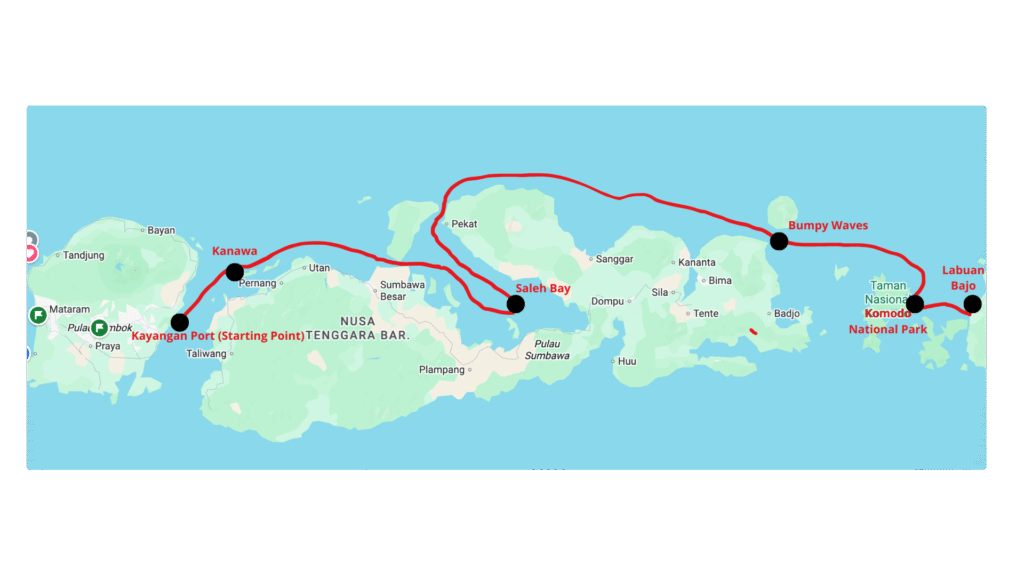
The route begins in Lombok, crosses the Lombok Strait, moves along the northern coast of Sumbawa, and continues east toward Flores before reaching Labuan Bajo.
Between Lombok and Sumbawa lies one of the strongest ocean current channels in Indonesia. It is completely normal for the sea to feel different here compared to calm Gili waters. Some days are smooth. Some days are more dynamic.
Experienced captains adjust speed and timing depending on wind direction and tide. That’s part of real sailing, and something worth understanding before booking.
Travelers technically could fly from Lombok to Labuan Bajo in under a few hours. So why choose 3 or 4 days at sea?
Because the sailing route is about transition.
You don’t suddenly “arrive” in Komodo.
You watch the landscape change gradually:
Lombok transfer experience
Sumbawa’s dry savannah coastline appears
Remote uninhabited islands rise from open water
The sea color shifts as you move east
For some travelers, this gradual movement is the highlight.
For others, it feels long. And that difference matters.
Many websites already talk about the beautiful 4 Days 3 Nights journey, the stunning destinations, the best months to visit Komodo Island, and the exciting activities you’ll experience along the way.
That information is important.
But here, we want to talk about something else.
Before you decide to sail from Lombok to Labuan Bajo, there are realities you should consider carefully. These are not deal-breakers, but they are things that shape your experience.
There are five major factors that truly matter.
If you sail from Lombok, your route will pass Sumbawa Island, cross open straits, and move through remote islands that are rarely accessible by land. The scenery is extraordinary, But from Sumbawa toward Komodo National Park, the journey includes a strait crossing.
This is where conditions change.
On the second night, Remark and remember the Sangeang Island. Here waves can become stronger as the boat enters open sea. It is completely normal for the boat to move more noticeably, left and right, up and down. The motion can feel significant, especially if you are not used to ocean crossings.
For travelers who are prone to seasickness, we strongly recommend preparing motion sickness medication for the second night. Taking it before sleeping can make a major difference, allowing you to wake up refreshed and ready for the next day’s activities inside Komodo National Park.
Many people underestimate this part of the journey.
The sea is part of the adventure, but it requires preparation.
Life on deck can be magical.
You will witness sunsets and sunrises over open water. You will see skies filled with stars far away from city lights. You will hear the sound of waves accompanying your journey.
But you are still on a boat.
Engines run while sailing, and you may hear mechanical sounds at night. Cabins are comfortable, but they are not five-star hotel suites. Storage space is limited. Menus may be simple and repeated over multiple days.
Even on luxury boats, this is still a maritime experience – not a floating resort.
The key to enjoying the trip is realistic expectations. Travelers who understand they are choosing an adventure at sea tend to enjoy it far more than those expecting hotel-level comfort.
This is not about lowering standards – it’s about understanding the environment.
Before confirming any tour, make sure you clearly understand what type of boat you will be boarding.
Many negative reviews online happen not because the trip was bad — but because expectations were unclear.
Some travelers book a “Komodo tour” without asking about:
Cabin type
Bathroom sharing or private
Engine size and stability
Crew ratio
Food standards
Safety equipment
When expectations are not aligned, disappointment follows.
To be objective: sometimes travelers do not ask enough questions, and sometimes operators do not explain enough details. Both sides share responsibility.
In general, boats are categorized as:
Standard Boats – Budget-friendly, basic facilities, simple cabins, functional but minimal comfort.
Deluxe Boats – Mid-range pricing, improved cabin comfort, better finishing, sometimes larger deck areas.
Luxury Boats – Higher price category, private bathrooms, more refined interior design, enhanced service.
However, even within these categories, quality can vary significantly. Not all “luxury” boats are equal, and not all standard boats are uncomfortable.
The most important thing is clarity before booking.
This may surprise some travelers.
Boats in Indonesia are not built with the same industrial systems or factory-standard engines you might find in Europe, Australia, or the United States.
Most wooden phinisi boats operating between Lombok and Labuan Bajo use custom-assembled main engines. In many cases, these engines are adapted from heavy-duty diesel truck engines – often former Mitsubishi Fuso or similar commercial vehicle engines – rebuilt and modified by local marine engineers.
This is not unusual in Indonesia.
It has been the standard system for decades.
These engines are powerful, durable, and widely understood by local mechanics. However, they are mechanical systems, and any mechanical system can experience issues. Not every week. Not every month. Sometimes not even every year. But it can happen.
If a technical issue occurs during your trip, the most important thing to do is remain calm.
Every licensed boat operating on this route has:
An onboard engineer
Experienced crew members
Backup communication systems
Many of these crew members have been working at sea for decades. Engine adjustments and minor mechanical troubleshooting are part of normal maritime operations.
In rare situations where a problem cannot be solved onboard, maritime patrol teams along the Lombok–Komodo corridor are active and responsive. Sea traffic is monitored, and assistance is available if required.
Understanding this reality does not mean expecting failure, it means understanding that you are traveling in a developing maritime region where craftsmanship and practical engineering replace factory-standard systems.
And that is part of the character of sailing in Indonesia.
Another topic that often creates mixed reactions among travelers is whale shark encounters in Saleh Bay, Sumbawa.
Many travelers are excited about the possibility of swimming near whale sharks. These animals are enormous, gentle, and unforgettable to witness in person.
However, there is an important ethical conversation around this activity.
In Saleh Bay, whale sharks are sometimes drawn closer to local fishing platforms because small fish are present in the area. Some local fishermen intentionally feed the sharks to encourage them to remain nearby. This practice has become controversial.
Some travelers – especially strong wildlife conservation advocates, believe that feeding alters the natural behavior of whale sharks and disrupts the ecosystem.
Others see it as a controlled interaction within a designated conservation area.
Saleh Bay is officially recognized as a conservation zone managed by local authorities. Monitoring and regulation efforts exist, though debates continue about best practices.
If you are considering a route that includes Saleh Bay, it is important to ask yourself:
Are you comfortable participating in wildlife encounters where feeding may be involved?
There is no universal answer, but being informed allows you to decide responsibly.
Responsible travel means understanding not only what you will see, but how it happens.
This article is important for anyone considering a Komodo sailing experience.
Komodo National Park is one of the most beautiful destinations in Indonesia, dramatic landscapes, prehistoric wildlife, raw ocean scenery. But because information is often incomplete or overly romanticized, many travelers end up blaming tour operators when reality does not match their expectations.
The truth is simpler.
The final decision is always yours.
If you choose to sail from Lombok, understand the route.
Understand the sea conditions.
Understand the boat category.
Understand the regional engineering standards.
Understand the wildlife ethics involved.
And most importantly, do not rely solely on Instagram content that shows only perfect sunsets and calm water.
Social media captures the highlight moments.
It rarely shows the engine noise at night, the movement of open sea crossings, or the practical side of maritime travel.
When you travel with awareness, when you follow crew instructions, respect the environment, and prepare yourself realistically, the journey becomes something far more meaningful.
It becomes not just a tour, but a real sea experience across one of Indonesia’s most extraordinary marine corridors.
And when expectations align with reality, the experience becomes unforgettable, for the right reasons.
Written by: Lalu Agus Ramansata (Komodo Tour Guide)